
Jättelänge sedan jag skrev nåt här. Har glömt hur man bäddar in.
Kolla denna video. Sprid den, vänligen.
https://youtu.be/3C-KHt9vi5k
Kolla denna video. Sprid den, vänligen.
https://youtu.be/3C-KHt9vi5k

Tänk om det var folkomröstning och folket fick valen:
1) Antingen låter vi, såsom nu, privata banker hitta på krediter som de skuldsätter stat och kommun med och folket får betala skatt för att betala dessa påhitt
eller
2) Staten skapar skuldfria pengar och spenderar ut till allmänna nyttigheter där det i demokratisk ordning röstas om att vad vi ska satsa på och vi slipper betala skatt till bankerna
Hur skulle du rösta?
Bankerna vill inte att vi ska veta vad pengar är och de vill att vi ska tro att deras krediter är pengar. De gör det krångligt genom att blanda ihop begreppen mellan pengar och fordringar på pengar.
Bostadsobligationer är t.ex inte pengar, krediter är inte heller pengar. Bankernas bostadsinstitut hittar på bostadsobligationerna där bostäderna utgör ”säkerhet” – men obligationer är inte pengar utan fordran på pengar. Krediterna som finns på kundens konton är också fordringar på pengar som kunden har på banken. Men banken vill att kunderna ska tro att bankens påhittade krediter är pengar. Och de gör allt för att vi ska använda deras påhittade krediter som pengar.
One man with courage is a majority !
Life in Libya under Gaddafi:
1. Electricity for household use is free,
2. interest-free student loans,
3. a former student receives the average salary for their profession if they do not find a job after graduation,
4. the state offers jobs in every professional area with degrees,
5. Every unemployed person receives social assistance 15,000 $ a year,
6. after the entry into marriage state pays first apartment or house (150m2),
7. cars are sold at factory prices,
8. no national debt to speak of,
9. free healthcare and education, at all levels, yes, even university
10. state funds scholarships to pay for higher education abroad to anybody willing to go,
11. 25% of the population are college graduates
12. 40 loaves of bread costs $ 0.15,
13. water infrastructure has been built in the middle of the desert, facilitating farming in Sahara,
14. gasoline costs 8 dinars per liter (0.08 EUR),
15. only 6% of Libyans are "poor",
16. For each infant, the couple receives $ 5,000 for their needs.
YEAH GADDAFI IS A CRUEL DICTATOR FOR SURE:
+
*welfare - 730 $./month
* nurse salary - $ 1000.
* newborn aid $ 7,000.
* marriage aid- $ 64 000 aid for buying an apartment
* private business aid - 20 000 $.
* very low taxes
källa: http://vaken.se/modules/smartsection/item.php?itemid=1127
Libyen attackeras på grund av deras statsägda centralbank
Published by Jin83 on 2011-04-14 (255 reads)
Libyen attackeras på grund av deras statsägda centralbank
Ellen Browns senaste artikel på Truthout beskriver hur Libyens starka ekonomi finansieras av centralbanken, som bland annat har enorma tillgångar i guld. Alla unga medborgare kan erhålla räntefria statslån på motsvarande 50 000 USD i Libyska Dinarer. Sjukvård och utbildningen är helt fritt. Visst har Libyen olja också. Men bara ca 2% av världsproduktionen. Men vad landet har som verkligen är en fara för de styrande krafterna i världen är den statskontrollerade centralbanken, helt självständig från BIS.
Libyen har dessutom agerat för att skapa en guldmyntfotsbaserad valuta, den traditionella muslimska Dinaren, att använda inom ett afrikanskt valutaområde. Dessa två faktorer är sannolikt huvudanledningen till NATOs attacker. Libyen är ett av de sista länder som inte underkastas de internationella bankirernas skuldnät. Och som aktivt strävar för att utöka sin frihet. Detta är något bankeliten inte tänker tolerera längre.
Klicka här för att läsa Ellen Browns artikel
alternativportalen.wordpress.com

Den ekonomidemokratiska rörelsen har visat att offentlig skuldsätting är ren politik - det vill säga något som vissa personer godkänner helt medvetet - trots att alternativ finns.
Genom att fullfölja de reformer ekonomidemokraterna rekommenderar kommer vi att bli av med inte bara statskulden, kommunala skulder - utan vi kan äntligen börja leva som det var tilltänkt - dvs mer avslappnat, utan " krav på ekonomisk tillväxt" och utan onödig överföring av inkomst till den privatägda finansiella sektorn.
Finanssektorn svindyra tjänster kallas högtidligt "finansiering" - men är de fakto inget annat än enkel bokföring som vilken som hest offentligt anställd kontorist kan administrera.

En ny ekonomidemokratisk era innebär att vi har råd att genomföra alla de projekt till vilka via harverkliga reala resurser: arbetskraft, byggmaterial, maskiner, utrustning och råmaterial.Framöver kan alla som påstår att vi har "brist på pengar" motbevisas. Fråga: Kan man ha brist på siffror i bokföringen? Svaret är uppenbart.
Någon inflation kommer inte att uppstå eftersom alla eventuella överloppspengar kan alltid tas ur cirkulation genom beskattning.
Ekonomidemokratiska reformer gör det möjligt att en rejäl grundinkomst kan betalas till medborgarna. Det hela är sist och slutligen en enkel sak att sköta och i sig självt en naturlig påföljd av industrisamhällets hutlösa framfart. Värdet av landets totalproduktionen och allt stigande produktivitet kan lätt omvandlas till en proportionlig och rättvis grundinkomst utan att man här behöver se några tecken på varken socialism eller vänstervridenhet.
Grundinkomstens största samhälleliga nytta är att den på mycket bred front gör det möjligt för hundratalstusen att förverkliga sin dröm - och sysselsätta sig själv.
Den kan bli ett abrupt slut på den systematiska utsugningen av det finska folket genom skuldsättning, ränta och skatter den dagen ekonomidemokraterna kommer åt att påverka dagens uppenbara missförhållanden.
Framtida generationer kommer att undra och skaka på huvudet då man begrundar hur finländska beslutsfattarna i sin dumdristighet så länge tillät finanskapitalisterna fortsätta med sin uppenbart parasititiska verksamhet - utan att man gjorde något åt det.
Slutligen : Jag upplever nog att jag är på rätt väg då jag beskådar all den stora mängd post som jag mottagit från folk runt om i landet. Till dags dato börjar vi ha närmare tusen supporterkort insamlade.
Thursday, March 31, 2011
Editorial note
The link to a new interview video with Richard Werner has been temporarily removed. Apologies for any inconvenience.
For other insights into banking, buy the book:
The Free Lunch- Fairness with Freedom
posted by Charles Bazlinton
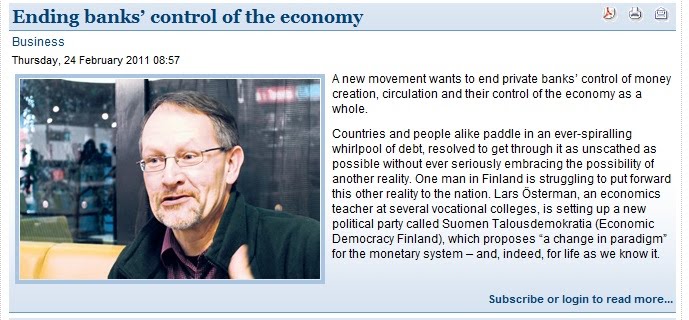
A new movement wants to end private banks’ control of money creation, circulation and their control of the economy as a whole.
Countries and people alike paddle in an ever-spiralling whirlpool of debt, resolved to get through it as unscathed as possible without ever seriously embracing the possibility of another reality. One man in Finland is struggling to put forward this other reality to the nation. Lars Österman, an economics teacher at several vocational colleges, is setting up a new political party called Suomen Talousdemokratia (Economic Democracy Finland), which proposes “a change in paradigm” for the monetary system – and, indeed, for life as we know it.

Blir minst sagt förvånad över att ECB låter irländska centralbanken förfalska 51 miljarder euro
Källor:Irland centralbank förfalskade 51 miljarder euro ur luften. Beloppets värde backas inte upp av statsobligationer. Inte heller är det ett lån från ECB eller någon annan. Pengarna är falska i alla bemärkelser.
Fakta i detta är att centralbanken ökar sina kontantstöd till irländska banker som finansieras av att institutionen skriver ut egna pengar .
Irish Independent redovisar i går kväll att Central Bank of Ireland finansierar € 51 miljarder i ett nödlåneprogram genom att skriva ut sina egna pengar.
Nu kan man väl säga att vi befinner oss på målrakan.


